

Uneven temperatures between floors aren’t a thermostat problem, they’re an airflow problem. Homeowners who keep chasing comfort by bumping the thermostat up or down are fighting the wrong battle, and every extra cycle costs them money. The fix lives in the ductwork, not on the wall.
Key Takeaways
- Adjust dampers near the plenum, not registers at room-level vents. Closing registers builds backpressure and causes duct leakage.
- Never close a manual damper more than 80-85%. Full closure can cause frozen evaporator coils in summer and furnace overheat shutdowns in winter.
- Lever parallel to the duct means open. Lever perpendicular means closed. Loosen the wing nut before adjusting or you’ll strip it.
- Map your duct branches before touching anything. Unlabeled ductwork makes systematic balancing impossible.
- Summer and winter require opposite damper settings. What works in July will leave the second floor freezing in December.
Dampers vs. Registers: You’re Probably Adjusting the Wrong One
The most common mistake homeowners make is closing room registers instead of adjusting branch dampers. These are two completely different components with different jobs.
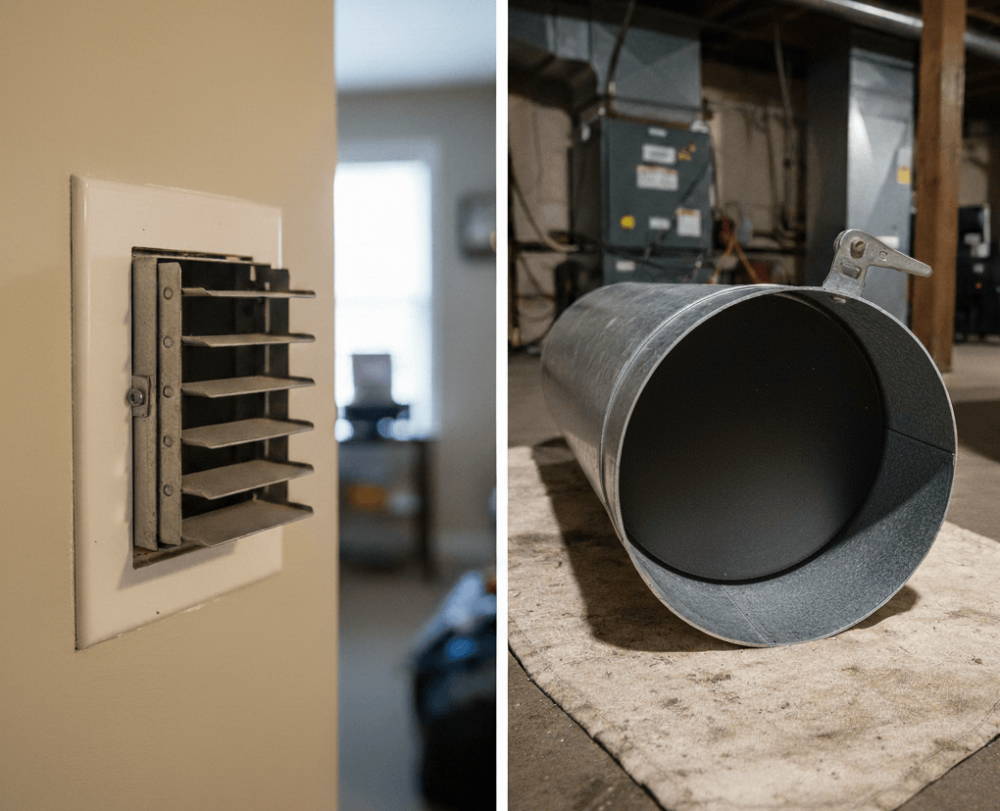
Registers are the slatted vent covers in ceilings and floors. The small lever on a register only redirects air within that room, it doesn’t reduce total airflow to that branch. Closing a register forces air to back up into the branch duct, creating turbulence, whistling, and pressure that pushes conditioned air out through duct seams into unconditioned spaces like attics and crawlspaces.
Dampers are heavy-duty metal valves located near the main supply plenum, right off the furnace or air handler. Because they sit at the origin of each branch, adjusting a damper controls how much air goes down that entire run before it ever reaches the registers. Balancing your home means working at the damper level, not the register level.
If your system has motorized zone dampers tied to a central control board and multiple thermostats, a stuck or non-responding zone is almost always a motor or sensor failure, not something you fix manually. That’s a zone controller troubleshooting issue. The guidance below applies to manual dampers.
The Four Mistakes That Kill Airflow Balance
1. Ignoring Seasonal Adjustments
Hot air rises, cold air sinks, and that physics problem shows up in your energy bill. A damper configuration dialed in for July will leave the second floor cold and the basement overheated come December.
Summer settings: Open the dampers feeding upper floors fully. Partially close dampers feeding the main level and basement. This forces cooled air upward where heat pools.
Winter settings: Flip the strategy. Partially close upstairs dampers and fully open downstairs dampers. Heated air delivered to the lowest level rises naturally, giving you even distribution across floors.
2. Closing Dampers Completely
Closing a manual damper 100% is the fastest way to create an expensive service call. HVAC systems are engineered to move a specific volume of air. When a blower motor runs against a fully blocked duct, static pressure spikes throughout the system.
Leave every “closed” damper at least 15-20% open. That’s enough to protect the system while still redirecting meaningful airflow where you need it.

3. Misreading the Lever Position
If you’re guessing what position a damper lever is in, you’re likely making the problem worse. The rule is simple:
- Lever parallel to the duct pipe = damper open, maximum airflow
- Lever perpendicular, 90 degrees to the pipe = damper closed, restricted airflow
Before adjusting any lever, loosen the wing nut at the base. That nut locks the handle in place so blower vibration doesn’t rattle the damper out of position over time. Forcing the lever without loosening the wing nut first strips the threads and makes the damper impossible to secure after adjustment.
4. Adjusting Without Mapping the System First
You can’t balance airflow you can’t trace. Branch dampers are typically in unfinished basements, crawlspaces, or utility rooms, and most are unlabeled. Before touching a single lever, turn the system fan on, have someone stand in a room, and tap the branch line you’re trying to identify. If they hear the tapping through their floor register, you’ve found the right duct. Mark it with a permanent marker, such as “Master BR,” “Kitchen,” or “Upstairs Bath.” This one-time 30-60 minute investment makes every future adjustment a five-minute job.
How to Balance Dampers Correctly
Step 1 – Reset to baseline. Open every room register fully. Set all manual dampers to the fully open, parallel position.
Step 2 – Run the system and take readings. Let the system run for several hours. Walk the house and note which rooms are over-conditioned and which are too warm or too cool.
Step 3 – Restrict the over-conditioned rooms. Go to your labeled ductwork. On the branch feeding a room getting too much air, loosen the wing nut and rotate the lever 30-45 degrees away from parallel. Retighten. This redirects pressure down branches serving harder-to-reach rooms.
Step 4 – Wait 24-48 hours before re-evaluating. Thermal mass takes time to respond to airflow changes. If a problem room still isn’t comfortable after 24-48 hours, restrict the over-conditioned branches another 10 degrees and repeat.
Step 5 – Mark your final settings. Once the home is balanced, mark each lever’s position with a permanent marker. Label summer settings “S” and winter settings “W.” The next seasonal transition takes five minutes instead of two days.
The Efficiency Payoff
A properly balanced system means the thermostat is measuring an accurate average of the whole home, not compensating for one problem room while over-conditioning everything else. The result is shorter run cycles, which directly reduces compressor and blower motor wear. According to the U.S. Department of Energy, sealing and properly balancing ductwork can reduce HVAC energy use by up to 20% in a typical home. For a system running $150-$200/month in peak season, that’s real money.
Damper balancing costs nothing but time. It’s one of the few HVAC maintenance tasks a homeowner can do themselves and see an immediate impact on comfort and utility bills.
