

A failed condenser fan motor will shut down cooling fast, and if it’s not caught early, the compressor follows. Replacing the motor yourself typically costs $100-$250 in parts versus $400-$700 for a service call, and for a contractor or capable DIYer with basic hand tools and electrical knowledge, it’s a same-day repair.
Key Takeaways
- Confirm the motor is the actual failure point before ordering parts. Check the contactor, capacitor, and thermal overload first.
- Match voltage, RPM, HP, frame size, and rotation direction when sourcing a replacement. Mismatching RPM destroys the new motor.
- Always discharge the run capacitor before touching any wiring. It holds a charge even with the power off.
- Buy a new run capacitor with every motor replacement. A weak capacitor can kill a new motor within months.
- Universal motors require you to follow the wiring diagram on the unit itself. Do not assume it matches the old motor’s configuration.
- Sealed-bearing motors need no oiling. Adding oil attracts dirt and causes premature failure.
Diagnose Before You Order
Grinding or humming without spin, warm air from the supply registers, or a compressor tripping on high-pressure lockout all point to the outdoor fan. But do not pull the motor until you have ruled out two faster fixes.
Check the Capacitor First
A failed run capacitor is the most common reason a condenser fan motor will not start. If the motor hums but will not turn, or turns only when you give the blade a manual nudge, the capacitor is the likely culprit, not the motor itself. Test it with a capacitor meter. A reading more than 10% below rated microfarads means it is due for replacement. A capacitor costs $10-$30. A motor costs ten times that.
Check the Contactor
If the thermostat is calling for cooling and 240V is reaching the contactor, but the fan still will not engage, check whether the contactor is pulling in. A stuck or pitted contactor can interrupt the circuit entirely. Swap it before condemning the motor.
Test the Motor Windings
For a definitive call, test resistance across the motor terminals with a multimeter. An OL, open loop, reading across the main power wires when the motor is cool means the internal windings are broken, and replacement is the only fix. A motor that is excessively hot to the touch, smells burnt, or has a blade that will not turn by hand with power off is also done.
Sourcing the Right Motor
Pull the data plate off the old motor before ordering anything. You need to match all five specs:
- Voltage – typically 208-230V for residential
- RPM – 825 or 1075; never mismatch
- Horsepower – 1/4, 1/3, or 1/2 HP; you can go slightly higher, never lower
- Frame size – most residential units use a 48-frame, 5.5" diameter
- Rotation – confirm the direction or buy a reversible motor
OEM motors are a direct swap but often require waiting on shipping. Universal motors from brands like Rescue or Titan are available same day at most supply houses and cost less, but demand close attention to the wiring diagram. A correctly matched motor running at proper RPM keeps that load where it belongs.
Browse condenser fan motors to find OEM and universal options by frame size and HP.
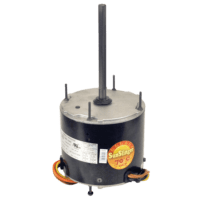
-
MSRP: $152.94You save 15%
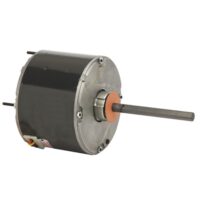
-
MSRP: $347.76You save 15%
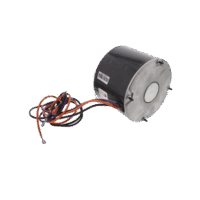
-
MSRP: $340.93You save 30%

Step-by-Step Replacement
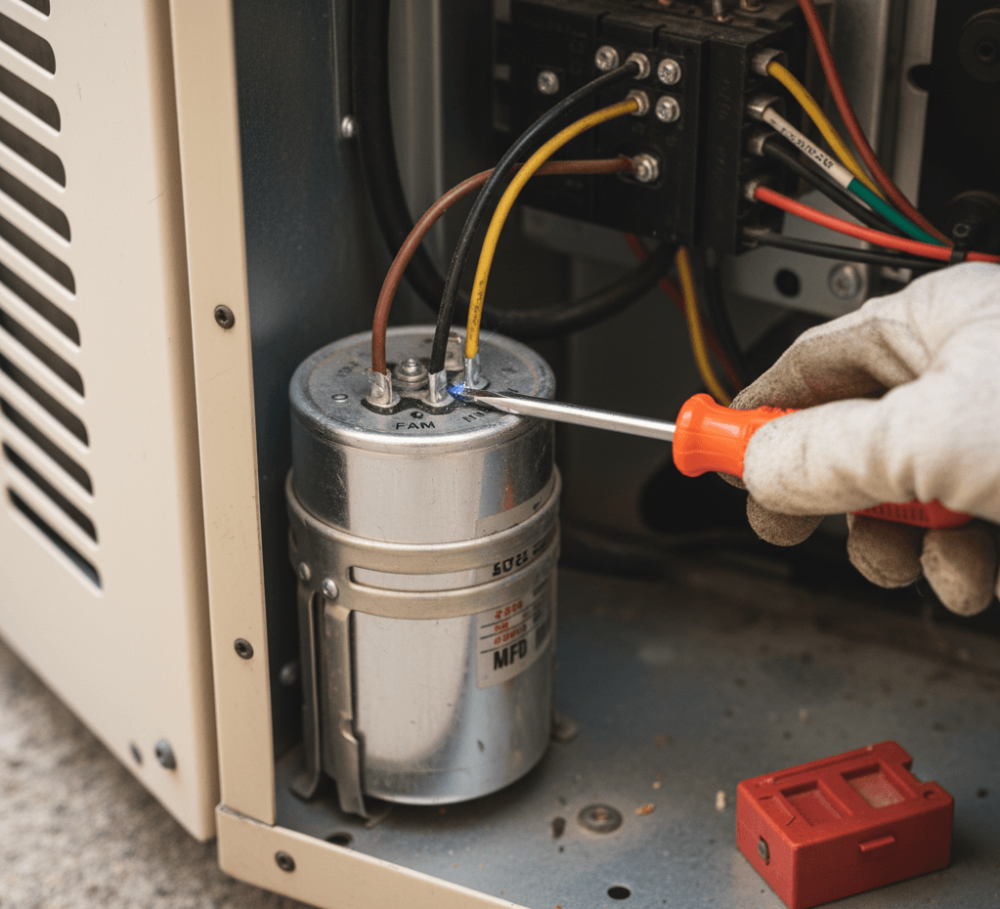
Step 1: Kill the Power and Discharge the Capacitor
Shut down at the thermostat, flip the breaker, and pull the disconnect block at the outdoor unit. The capacitor still holds a charge. Short the terminals, Common to HERM and then Common to FAN, using an insulated-handle screwdriver before touching any wires.
Step 2: Remove the Fan Assembly
Remove the top grille screws and lift the grille with the motor attached. Flip the assembly upside down and rest it on the unit frame. Photograph every wire connection before disconnecting anything. Disconnect the motor leads from the contactor and capacitor terminals.
Step 3: Pull the Fan Blade
Loosen the set screw and expect resistance. The hub almost always oxidizes onto the shaft after a season or two outdoors. Use a fan blade hub puller rather than prying; aluminum blades bend easily and an unbalanced blade will wear out the new motor’s bearings fast.
Step 4: Wire the New Motor
OEM motor: wire it one-for-one using your photos. Universal motor: follow the diagram printed on the motor housing, not memory.
- 3-wire motors: Black and Yellow to the contactor, Brown to the Fan terminal on the capacitor
- 4-wire motors: Black and Yellow/White to the contactor, Brown leads to a dedicated fan capacitor
Install the new run capacitor at the same time. It is a $15-$30 part, and the single most common reason a new motor fails early.
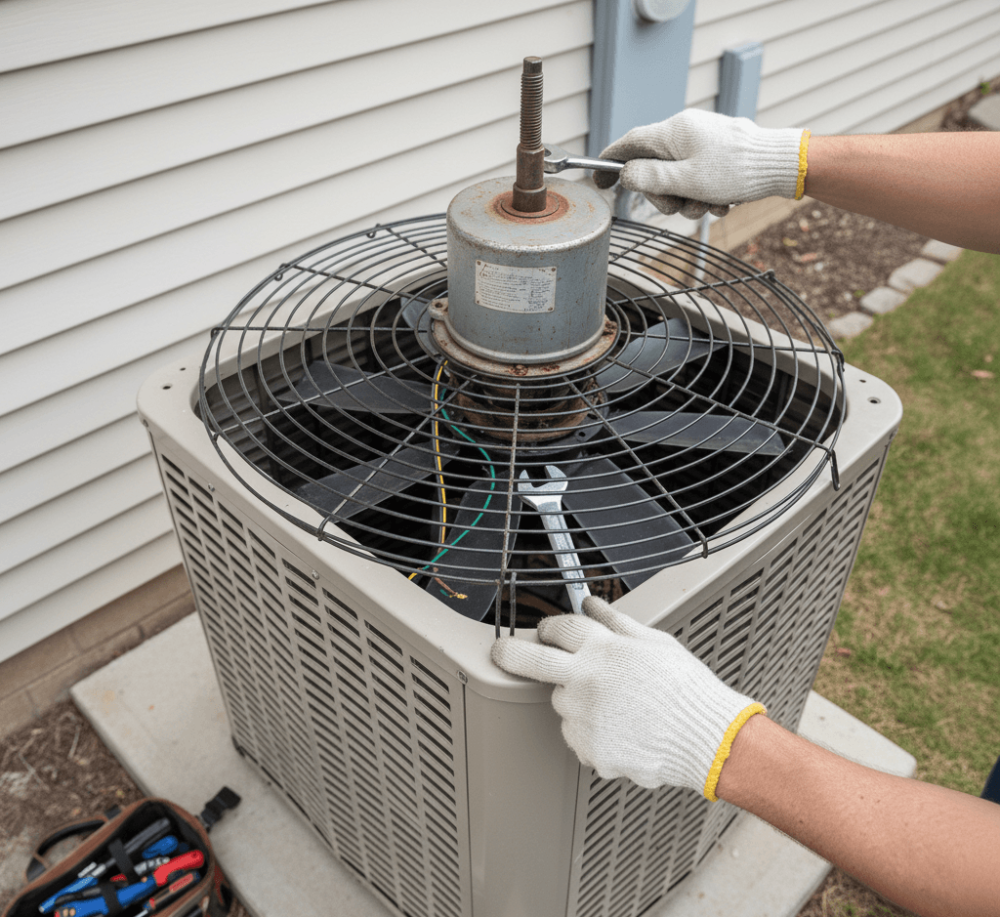
Step 5: Mount the Motor and Reinstall the Blade
Slide the rain shield, or slinger ring, onto the shaft before the fan blade. It spins water away from the bearings. Skip it and you may be back out there next season. Seat the blade at the same depth as the old motor, tighten the set screw against the shaft flat, and torque the mounting bolts enough to eliminate vibration.
Step 6: Verify Rotation Before Closing Up
Power the unit on and call for cooling before securing the grille. Condenser fans pull air in through the side fins and push it straight up and out the top. If air is blowing out the sides, the motor is spinning backward. Power down, discharge the capacitor again, and swap the two rotation-reversing leads, usually orange or yellow quick-disconnects on universal motors. Reverse is a two-minute fix when the unit is still open. It is a full disassembly job after you have buttoned it up.
Ongoing Maintenance
Keep the area around the condenser clear of debris and overgrowth. A restricted airflow path forces the motor to work harder, raises operating temperature, and shortens bearing life. Check fin condition and clean with a fin comb or low-pressure rinse at the start of each cooling season.
If the replacement motor has sealed bearings, as most modern units do, leave them alone. Oiling sealed bearings introduces contamination and shortens their life. Non-sealed motors with exposed oil ports take 3-4 drops of SAE 20 non-detergent oil annually, applied at the ports near the top and bottom of the casing.
A correctly installed motor with a fresh capacitor should run 8-12 years under normal conditions. The ones that fail early almost always come down to a mismatched spec, a reused capacitor, or a restricted condenser.
