A humming outdoor unit with a fan that won’t spin is one of the most common summer service calls, and one of the cheapest fixes when you catch it early. A failed run capacitor is usually the culprit, and a replacement part typically costs $15-$30. The average service call to diagnose and swap one runs $250-$350. Knowing how to test it yourself keeps that money in your pocket.
Key Takeaways
- Cut power at both the breaker and the outdoor disconnect before opening the unit.
- Discharge the capacitor across all terminal combinations before touching anything. Even with power off, a charged capacitor can deliver a painful shock.
- Use a multimeter with a microfarad, MFD/µF, setting to measure capacitance.
- Apply the 6% rule: a reading more than 6% below the rated MFD means the capacitor is failing.
- An “O.L.” reading means the internal circuit is open. Replace immediately.
- A capacitor that passes the bench test but still will not spin the fan points to a seized motor, not the capacitor.
Cut Power Before You Touch Anything
Flip the AC breaker in your main panel to the off position, then pull the disconnect block from the small weatherproof box mounted near the outdoor condenser. Both steps are required. The breaker kills the main feed, and the disconnect block ensures the unit is fully isolated. Do not skip the disconnect. Some units have a delay relay that can re-energize a circuit unexpectedly.
Tools you’ll need:
- Insulated screwdriver with a rubber or plastic handle; no metal-shaft tools
- Safety gloves
- Multimeter with MFD, microfarad/µF, capacitance setting

Do a Visual Check First
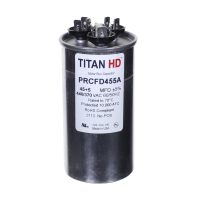
Before you pull out the meter, look at the capacitor. It is the silver cylinder inside the service panel, usually mounted against the side wall.
Two visual signs tell you it is dead without any testing:
- Bulging or domed top – a flat-top capacitor that has mushroomed upward has failed.
- Oil residue or dark leaking fluid – internal dielectric failure means the capacitor should be replaced.
If either is present, skip the meter test and order the replacement. Match the voltage rating, 370V or 440V, and the MFD rating printed on the label exactly.

Discharge the Capacitor Before Testing
A run capacitor holds a charge even after power is disconnected. A dual-run capacitor rated at 370V or 440V can deliver a significant jolt if you bridge the terminals accidentally. Discharge it before handling.
To discharge safely:
- Grip your insulated screwdriver by the handle only.
- Touch the metal shaft across two terminals simultaneously.
- Hold for 3 seconds. A small pop or spark is normal.
- Repeat across every terminal combination: C-to-HERM, C-to-FAN, and HERM-to-FAN.
Once all combinations have been bridged, the capacitor is safe to handle and disconnect.

Safety note: If you are not comfortable working around electrical components, stop here and call a qualified HVAC technician.
Identify the Terminals
A dual-run capacitor has three terminal clusters stamped into the top:
- C, Common – shared reference point; one probe always goes here.
- HERM – connects to the hermetic compressor.
- FAN – connects to the condenser fan motor.
A start capacitor only has two terminals and no FAN terminal. If you are working on a dual-run capacitor, the MFD rating on the label is a split value, something like 45/5 µF. The larger number, 45, is the compressor side. The smaller number, 5, is the fan side.
Run the Multimeter Test
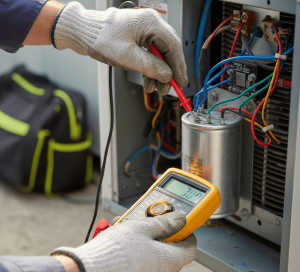
Set your multimeter to the capacitor or MFD symbol. Some meters auto-range; others require you to select a range that covers the rated value.
Test procedure:
- Hold one probe on the C terminal.
- Touch the second probe to HERM and wait for the reading to stabilize.
- Move the second probe to FAN and repeat.
Compare each reading against the label. Apply the 6% rule: the actual reading can be up to 6% above or below the rated MFD and still be considered acceptable. For a 45 µF rating, the acceptable range is 42.3-47.7 µF. A reading below 42.3 µF means the capacitor is weak and will struggle to start the compressor under load, especially on hot days.
If the screen shows O.L., or Open Loop, the internal circuit is broken. The capacitor is dead regardless of what it looks like visually.
When the Capacitor Tests Fine but the Fan Still Won’t Spin
A capacitor that passes the bench test is not always the whole story. If the readings are within spec but the fan still will not turn, the motor itself is likely the problem.
With power disconnected, use a wooden dowel or non-conductive stick to manually nudge the fan blades. If they do not move freely, the motor bearings have seized. A good capacitor cannot spin a locked motor. At that point, you are looking at a motor replacement, not a capacitor swap, which is a different cost conversation with the homeowner.
High ambient temperatures can also cause a borderline capacitor to fail under load even when it tests within tolerance on the bench. If everything checks out electrically and mechanically but the system still struggles on the hottest days, a load test under operating conditions is the next step.
Replacing the Capacitor
Once you have confirmed the capacitor is the failure point:
- Photograph the wiring before disconnecting anything.
- Note the voltage and MFD ratings. Match both exactly on the replacement.
- Remove the old capacitor from its mounting bracket.
- Reconnect wires to the correct terminals using your reference photo: HERM to HERM, FAN to FAN, and C to C.
- Secure the new capacitor in the bracket.
- Replace the service panel cover, restore the disconnect block, and flip the breaker back on.
A compressor that was struggling to start on a weak capacitor will often sound noticeably different once a new capacitor is in: cleaner startup, immediate fan spin, and no hesitation. That is your confirmation the diagnosis was right.
Related Capacitor Products
-
MSRP: $12.08You save 15%
-
MSRP: $9.78You save 15%