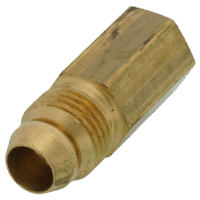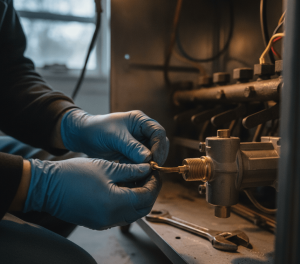
A compression fitting is one of the most common ways to make a tight, leak-free connection between a piece of tubing and a component without soldering, brazing, or flaring. On HVAC equipment you see them most often on pilot tubing, gas control assemblies, and small-diameter fuel and sensing lines. Anywhere a clean, serviceable joint matters more than a permanent one.
Done right, a compression joint holds pressure for years. Done wrong, it weeps gas or leaks under load. Knowing how the parts work together is what separates a reliable connection from a callback.
Key Takeaways
- A compression fitting seals by deforming a soft metal ring, the ferrule, onto the tubing as the nut is tightened. No heat, flux, or flaring required.
- The three parts are the fitting body, the compression nut, and the ferrule. All three must match the tubing OD, commonly 1/8" or 1/4" on HVAC pilot lines.
- Tighten finger-tight, then turn the nut roughly an additional 1-1/4 turns with a wrench. Overtightening crushes the ferrule and causes leaks. It does not fix them.
- Use the fitting rated for the application. Gas pilot tubing should use a fitting matched to the specific gas control. Do not improvise with a mismatched ferrule.
- Always leak-test gas connections with a solution or electronic detector before leaving the job.
How Compression Fittings Work
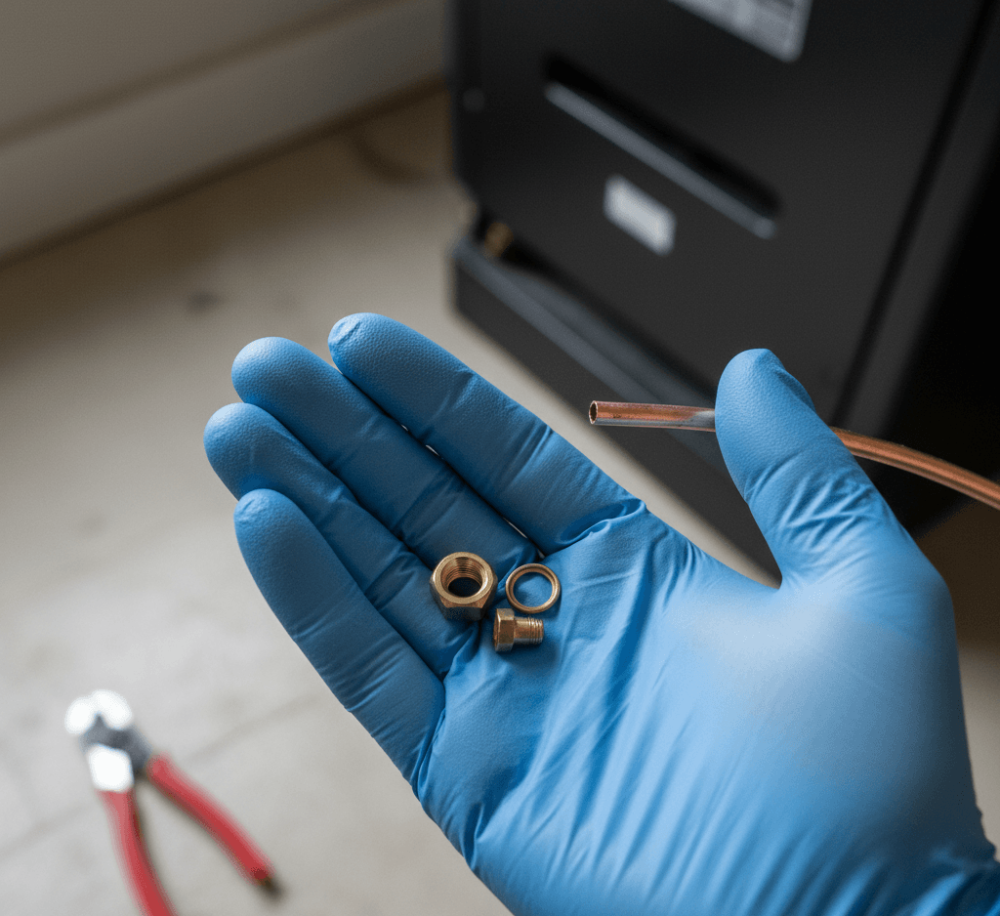
Every compression fitting comes down to three pieces working in sequence: the body, the nut, and the ferrule. The body is threaded and has a tapered seat machined into the opening. The nut threads onto the body, and the ferrule, a small ring of brass or other soft metal, sits between them, slipped over the tubing.
When you slide the tubing into the body and start tightening the nut, the nut drives the ferrule forward into the tapered seat. That taper squeezes the ferrule down onto the outside of the tubing, biting in slightly and forming a metal-to-metal seal in two places at once: against the tubing OD and against the seat in the body. There is no gasket and no adhesive. The seal is purely the deformed ferrule clamping the line.
This is why the additional turn past finger-tight matters. Finger-tight only seats the parts. The extra 1 to 1-1/4 turns is what actually deforms the ferrule enough to seal. Stop short and it weeps; go too far and you crush the ferrule out of shape, deform the tubing, or strip the threads. None of that can be fixed by tightening harder.
Why the Match Matters
The ferrule only seals if it is sized exactly to the tubing OD and seated in a body with the correct taper. A 1/4" ferrule on 1/4" tubing seals; the same ferrule forced onto a different line will not. On gas controls this is doubly important, because the fitting also has to match the port on the valve or pilot burner. That is why manufacturers spec specific fittings for specific controls rather than a one-size-fits-all part.
Making a Reliable Compression Joint
- Cut the tubing square with a tubing cutter, not a hacksaw, and deburr the end. A clean, round, burr-free cut is the single biggest factor in whether the ferrule seals.
- Slide the nut onto the tubing first, then the ferrule, in the correct orientation. Get them backward and the joint will never seal.
- Insert the tubing fully into the fitting body so it bottoms against the seat, then thread the nut on by hand until finger-tight.
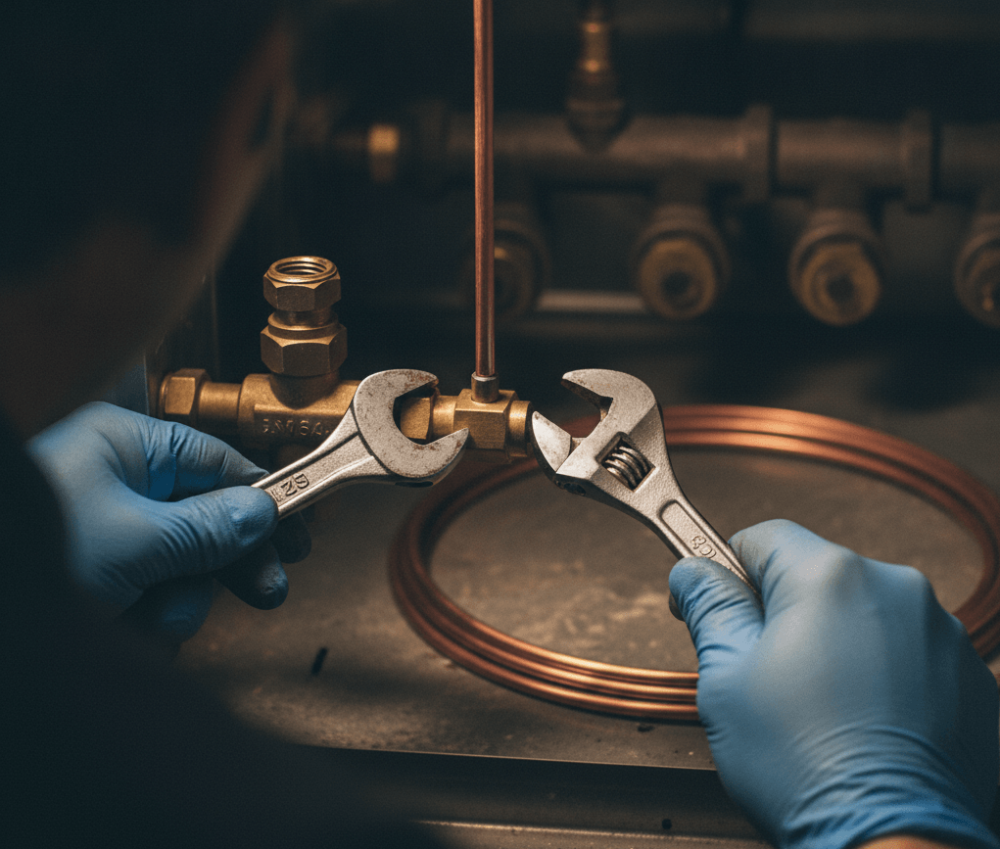
- Hold the body with one wrench and turn the nut about 1 to 1-1/4 turns with another. Backing up the body keeps you from twisting the tubing or stressing the valve port.
- Leak-test under pressure. On gas work, that means a bubble solution or an electronic detector. Every time, no exceptions.
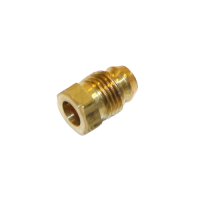
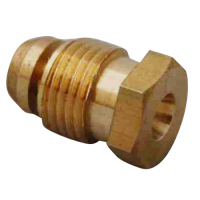
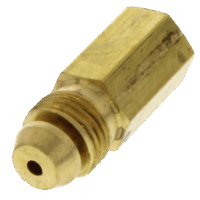
A few common HVAC compression fittings show how application-specific these parts are. The Honeywell/Resideo 392449-1 connects 1/8" OD pilot tubing to a long list of Honeywell pilot burners and combination gas valves, including V800, VR8200, VR8300, and others. For 1/4" OD pilot tubing on Honeywell/Resideo combination gas controls, the 386449-1 and longer 386449-4 nut-and-ferrule assemblies cover most layouts. The BASO FTG75-1H is a male-thread fitting for 1/8" tubing, and the Reznor 9664 is a 1/4" nut-and-ferrule set for Reznor equipment. The takeaway is the same in each case: pick the fitting built for the tubing size and the control you’re landing on.
The Bottom Line
Compression fittings give you a strong, serviceable, leak-free joint without a torch, but only when the parts match the tubing and the joint is tightened correctly. A square cut, the right ferrule, the right number of turns, and a leak test are all it takes to make one that lasts. Treat the fitting spec on the gas control as a requirement, not a suggestion, and the connection will hold.
-
MSRP: $24.27You save 15%
-
MSRP: $7.91You save 15%
-
MSRP: $16.15You save 13%
-
MSRP: $6.27You save 15%