
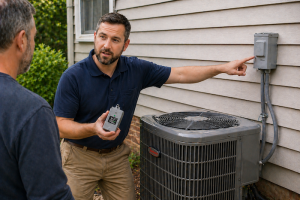
Most homeowners hear surge protector and picture the $15 power strip under their TV. When you quote them $150 installed for a dedicated HVAC surge protective device, the math doesn’t immediately add up in their head. Your job is to make it add up quickly and clearly before they decline the add-on and you move on to the next call.
This guide gives you the numbers, the framing, and the product knowledge to close that conversation with confidence every time.
Key Takeaways
- A dedicated HVAC surge protective device, SPD, costs $15-$80 in parts. Fully installed, plan to bill $75-$200 depending on complexity, or $150-$300 when bundled with a new disconnect.
- A single compressor replacement runs $800-$2,500+ in parts alone. A control board is $300-$900 for standard boards. An ECM motor is $400-$1,000. One surge event that isn’t absorbed pays for years of protection.
- Lightning is not the main threat. The most common surge sources are utility switching, neighbor load startup, and the HVAC system’s own motor cycling; these happen constantly.
- Modern high-efficiency equipment, including inverter-driven compressors, ECM motors, and variable-speed boards, is significantly more sensitive to transient voltage than older single-speed systems.
- The right product depends on the application: standalone SPD, disconnect with integrated surge, voltage monitor combo, or commercial 3-phase device.
- Products with connected-equipment warranties give homeowners a concrete financial backstop. Lead with that number in your pitch.
How to Frame the Conversation at the Job Site
Don’t lead with the product, lead with what’s at risk. At the end of a new install or a maintenance visit, a straightforward framing works well:
“This system has a $500 control board and a $600 ECM motor. A surge protector runs about $150 installed. If a surge hits without one and that board fries, you’re paying for a service call plus parts. This is the cheap insurance.”
That’s not a hard sell. It’s an honest risk conversation. Most homeowners respond well when the math is laid out plainly. The ones who push back are usually underestimating how frequently small surges occur, or assuming their utility or homeowner’s insurance will cover the damage. Neither is a reliable backstop.
Handling the “I Already Have a Whole-Home Surge Protector” Objection
Panel-mounted whole-home devices are designed primarily for large external events. They don’t catch the smaller, repetitive transients generated internally, from motor startups, utility switching, and load cycling, that do cumulative damage to inverter boards and control electronics over time. A point-of-use SPD at the disconnect is a second layer of protection, and layered protection is the same approach used in commercial installations. Both can coexist without conflict.
Handling the “Is It Really Necessary?” Objection
High-efficiency systems are the most voltage-sensitive equipment most homeowners own. A 16 SEER2+ inverter system runs variable-speed compressor algorithms through a sophisticated inverter board. It is far more susceptible to transient damage than the single-speed compressors of 15 years ago. The same applies to ECM blower motors and modulating gas valves. The more electronic sophistication in the system, the higher the cost of a surge event, and the stronger the case for protection.

The Numbers: What You’re Protecting Against
Being specific about repair costs makes the value case concrete. Here’s what surge damage typically runs when an SPD isn’t in place:
- Compressor replacement: $800-$2,500 in parts, plus labor. On a newer high-efficiency unit, all-in costs can exceed $3,000. On larger or variable-speed systems, $4,000-$5,000 is not uncommon.
- Control board replacement: $300-$900 for standard boards, plus diagnostic time. Modern smart and ECM-compatible boards can run higher. Many boards are system-specific with lead times.
- ECM blower or condenser motor: $400-$1,000 depending on brand and speed rating.
- Inverter/VFD board on a mini-split or variable-speed system: $400-$900+, with some OEM boards running higher.
- Transformer or sensor damage: $75-$200 per component, but a surge often takes multiple components at once.
Compare that to the installed cost of surge protection: $75-$200 for a standalone SPD, or $150-$300 when bundled into a disconnect combo. On a $5,000-$15,000 system, that’s well under 2% of equipment value for a device that can absorb hundreds of surge events over its lifetime.
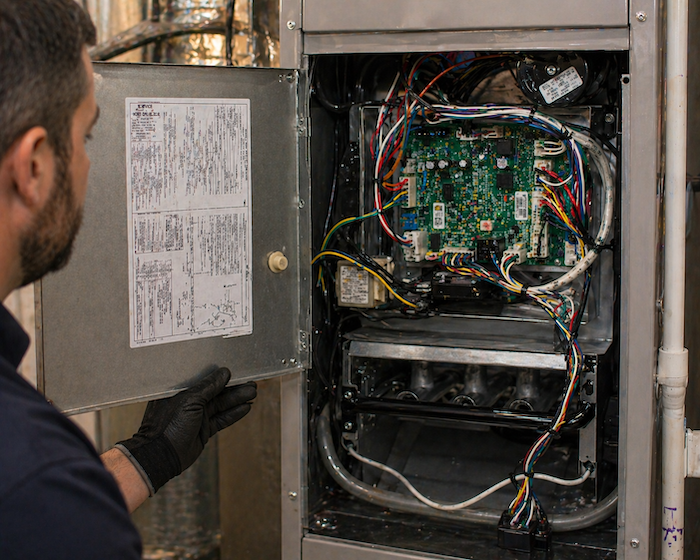
Picking the Right Product for the Job
Matching the product to the application keeps material costs reasonable and install time efficient. Here are the six scenarios you’ll run into most often.
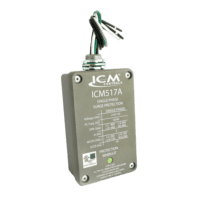
1. Residential Single-Phase – Condensing Unit or Split System
Example: ICM Controls ICM517A
The ICM517A is a reliable go-to for standard 120/240V single-phase systems. It uses thermally protected MOV technology, is NEMA 4X rated for outdoor installation, and installs at the disconnect via a 3/4" conduit connection. It’s rated for up to 100,000 amps of surge current and it comes with a $25,000 connected-equipment warranty, which is a strong closing point with homeowners. Cast aluminum enclosure means it holds up in harsh environments better than plastic alternatives.
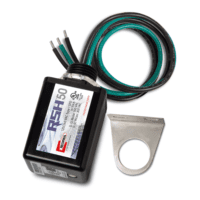
2. Furnaces and Air Handlers, 120V Indoor Equipment
Example: RectorSeal RSH-50, 96415
Indoor HVAC equipment running at 120V needs its own protection; the condensing unit SPD doesn’t cover it. The RectorSeal RSH-50 is a compact single-phase device built for furnaces, air handlers, and ductless systems running at 120/240V. It uses a hybrid of Gas Discharge Tube and TFMOV technology for protection, installs at the disconnect with pre-stripped leads, and carries a NEMA 4X rating for indoor or outdoor use. The green LED makes it easy to confirm status on the way out the door. There’s no reason not to put one on every furnace job.

3. New Installs – Disconnect with Integrated Surge Protection
Example: ICM Controls ICM495-60A
When you’re doing a full install or replacing a disconnect anyway, an integrated unit is the cleanest option. The ICM495-60A is factory pre-wired, UL Listed for both the enclosure and the SPD, and eliminates the need for a separate conduit knockout. It handles 100kA maximum surge current, uses two high-quality TFMOVs, and carries a $10,000 connected-equipment warranty. NEMA 3R metal enclosure rated for indoor or outdoor use. Made in the USA. The 30A fused version, ICM495-30A, is available for smaller equipment.
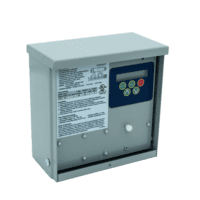
4. Mini-Splits and Inverter-Driven Systems
Example: ICM Controls ICM493
Mini-split inverter boards are among the most expensive and most vulnerable components in residential HVAC. The ICM493 is a single-phase line voltage monitor with integrated surge protection, making it one of the most capable options for this application. It monitors for over and under voltage and disconnects the load when conditions fall outside safe limits, not just transient spikes. It also includes a bank of five L-L surge arresters plus a built-in 40A contactor, and mounts in a NEMA 3R enclosure between the service disconnect and the condensing unit. The backlit digital display makes it easy to check status on site. A 60A version, ICM493-60A, is available for larger equipment. If the homeowner is asking why their mini-split keeps faulting, voltage irregularities are frequently part of the answer, and the ICM493 will tell you exactly what’s happening.
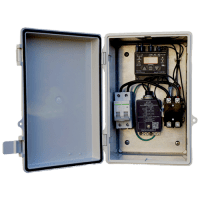
5. Problem Locations – Voltage Monitoring Plus Surge Protection
Product: ICM Controls Sentry 3N1
For homes with known power quality issues, rural utility feeds, older infrastructure, or recurring brownout complaints, a standard SPD isn’t enough. The Sentry 3N1 combines an ICM517A surge protective device, an ICM492 voltage monitor, and a 40A disconnect breaker in one pre-wired enclosure. It protects against over-voltage, under-voltage, and rapid short cycling, not just transient spikes. The LCD display and 5-fault memory let you and the homeowner see exactly what voltage events have occurred. This is a premium add-on that justifies a higher install price and positions you as the contractor who thinks beyond the basics.
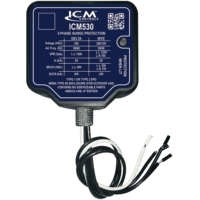
6. Light Commercial – Three-Phase Equipment
Product: ICM Controls ICM530
For three-phase commercial equipment at 240V, Delta or Wye 120/208V, the ICM530 is a UL Listed Type 1 and 2 SPD in a NEMA 4X watertight enclosure rated for indoor or outdoor installation. TMOV technology with thermal protection, green LED status indicator, and a short-circuit current rating of 200kA RMS. It connects directly to the electrical panel or disconnect. For 480V applications, Delta or Wye 277/480V, the ICM531 is the equivalent three-phase solution.
Make It a Standard Practice, Not an Upsell
The most effective contractors don’t present surge protection as an optional add-on. They present it as part of how they do installs. “We always put a surge protector on the system” is a stronger position than “would you like one?” The first framing treats it as professional standard. The second opens a negotiation.
When you itemize it, be specific. “The ICM517A goes on the condensing unit disconnect. It’s rated for 100,000 amps of surge current and comes with a $25,000 connected-equipment warranty. It’s $X installed.” A specific product with a specific warranty number lands better than a vague claim about protection. Homeowners who research the product will find the warranty, verify the specs, and feel confident in the recommendation.
Surge protection is one of the few add-ons where the value case is completely objective. You’re not selling comfort or efficiency gains that are hard to quantify. You’re presenting a straightforward insurance transaction: pay $150 now, avoid a potential $1,500 repair call later. When homeowners hear it that way, with real numbers attached, most say yes.
